00
Raw web video
Human-motion videos crawled from YouTube, Kinetics-700, HOIGen, VideoUFO and more — unfiltered, noisy, fully in-the-wild.
125K hours ~14 years
A Large-Scale, Richly Organized Dataset and Semantic Taxonomy for Human Motion Generation
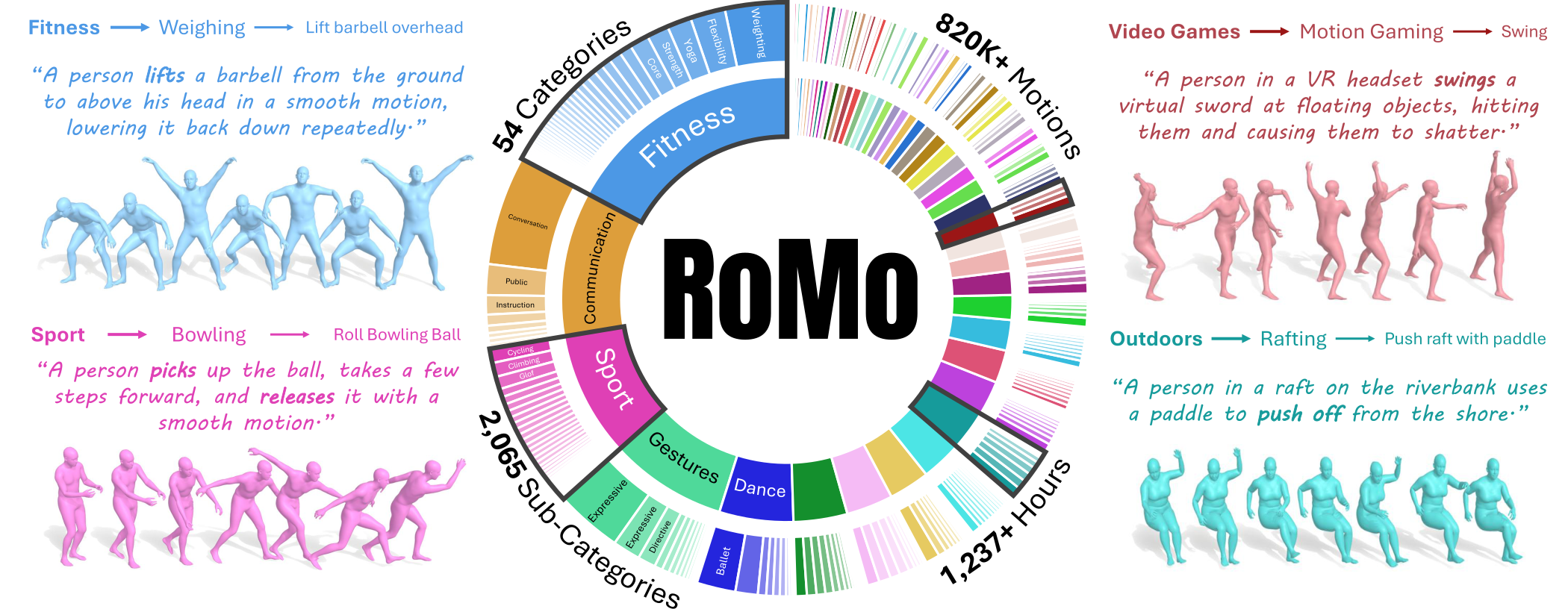
Success in generative modeling across language, image, and video demonstrates that large, well-curated datasets are the key driver for building capable models. 3D human motion, however, has lagged behind, constrained by an unsatisfying choice between small, high-fidelity motion capture datasets and large-scale in-the-wild collections dominated by static or low-quality sequences.
We introduce RoMo, a rich, large-scale, carefully curated dataset of in-the-wild human motions that resolves these tradeoffs. To ensure quality, we introduce a taxonomy-aware filtering pipeline that aggressively removes static and artifact-prone sequences. Every sequence is annotated with detailed captions and organized by a novel three-level semantic taxonomy. This hierarchical structure enables fine-grained, per-category evaluation that reveals model strengths and weaknesses obscured by global metrics.
We demonstrate that models trained on RoMo achieve state-of-the-art fidelity and diversity while gaining a superior understanding of complex, subtle text prompts. Finally, we release the Motion Toolbox to standardize metrics, data conversion, and visualization, establishing a foundation for reproducible and interpretable motion generation research.
Drag to orbit · scroll to zoom. Every clip is a real RoMo sequence rendered from its GLB.
No clips for this category.
Two displayed levels — 54 categories → 2,065 subcategories. Click a node to expand; toggle the sunburst sized by sequence count.
An uncompromising pipeline distills ~14 years of raw web video down to 1.3K hours of high-quality, well-annotated motion — about 1%. Scroll to walk through each filter.
Human-motion videos crawled from YouTube, Kinetics-700, HOIGen, VideoUFO and more — unfiltered, noisy, fully in-the-wild.
An LLM screens each video's metadata: it must depict a real human action, a single person, with the full body visible, and not be AI-generated. Clips below 24 FPS are dropped.
PySceneDetect splits transitions and discontinuities into clean shots; near-static scenes are removed using inter-frame differences.
YOLOv8 keeps clips dominated by a single prominent person; ViTPose 2D-pose checks reject heavy truncation and tiny subjects.
GVHMR lifts each clip into a 3D SMPL sequence (24 joints, resampled to 30 FPS); low-quality reconstructions are filtered out.
An adaptive, per-category dynamic-score threshold removes static and low-activity clips — the final quality gate before the dataset.
Interactive Plotly figures — hover, zoom, and toggle. Generated from the RoMo dataset.
Core clip counts and hours from Table 1 of the paper; hover for caption diversity.
Motion sequence counts and percentages from the source-distribution figure.
Category counts from the RoMo data; total = 813,938 sequences.
t-SNE of Sentence-T5 caption embeddings. RoMo spans a broader semantic space than prior datasets.
A single library to standardize how motion datasets are measured, converted, and viewed.
Unified FID, diversity, multimodality and per-category scores so results are comparable across papers.
Convert between SMPL, R15, and common motion formats with consistent root-motion handling.
One-line GLB rendering and side-by-side comparison — the same pipeline powering this gallery.
@inproceedings{Zhang2026RoMo,
  author    = {Zhang, Jiahao and Liu, Joseph and Lee, Young-Yoon and Moon, Seonghyeon and Zordan, Victor and Tevet, Guy and Liu, Karen and Gould, Stephen and Jacob, Oren and Jiang, Haomiao and Kapadia, Mubbasir and Ben-Shabat, Yizhak},
  title     = {RoMo: A Large-Scale, Richly Organized Dataset and Semantic Taxonomy for Human Motion Generation},
  booktitle = {Conference on Computer Vision and Pattern Recognition (CVPR)},
  year      = {2026},
}